
Priming Miniatures: Black, Grey, or White, and When Zenithal Is Worth It
By BrushBench . 9 min read . Updated September 2026
Every miniature painting session starts the same way: decide on a primer color, then get it on the model before any paint touches plastic or resin. The choice sounds small until you notice how much of the rest of the paint job it sets up. Citadel Chaos Black Spray Primer shades automatically and forgives mistakes. Army Painter Color Primer Matt White Spray makes bright colors and speedpaint formulas pop. Vallejo Surface Primer Grey (200ml) sits in the middle and pairs with a brush-on option like Badger Stynylrez Airbrush Primer (2oz) or a full airbrush setup. This guide walks through picking a color, picking an application method, and deciding whether zenithal priming is worth adding to your process.
Quick answer
Black primer such as Citadel Chaos Black Spray suits dark schemes and needs fewer coats. White primer like Army Painter Color Primer Matt White Spray makes bright colors pop, and grey primer such as Vallejo Surface Primer Grey is the flexible default. Zenithal priming, spraying black low and white from above, earns its extra step once you own an airbrush.
This guide contains affiliate links. BrushBench may earn a commission at no cost to you.
What primer color should you choose for a new miniature?
Citadel Chaos Black Spray is the traditional default because black naturally shades every recess and lets dark color schemes get away with fewer finishing coats, while lighter primers trade that built-in shadow for brighter starting colors. Reach for Citadel Chaos Black Spray Primer whenever a color scheme leans dark or you are still learning to control your brush, since it hides small mistakes better than any other primer color.
White primer flips that trade. Army Painter Color Primer Matt White Spray gives bright yellows, oranges, and pale skin tones a clean base to build on, since those colors struggle to cover a dark surface without turning muddy. It is also the base most speedpaint and contrast-style formulas, including Army Painter Speedpaint 2.0 Mega Set, are designed to sit on top of, since the self-shading effect needs light to show through the thin paint on raised areas.
Grey sits between the two. Vallejo Surface Primer Grey (200ml) makes it easier to spot mold lines, gaps, and missed spots before you commit to a color scheme, since neither dark shadow nor bright white is hiding the surface detail. It also plays reasonably well with almost any paint scheme, which makes it the safer default when you have not decided on colors yet.

Citadel Chaos Black Spray Primer
The most-documented rattle-can primer in the hobby, a black basecoat and primer in one that works out of the can on any primed-plastic or metal miniature.

Army Painter Color Primer Matt White Spray
White rattle-can primer that bonds to plastic and metal and provides a bright base for contrast paints, bright colour schemes, and bone tones.

Army Painter Speedpaint 2.0 Mega Set
50-colour set of Army Painter's self-shading speedpaint formula, improved over version 1.0 for reduced reactivation when layering over dried coats.

Vallejo Surface Primer Grey (200ml)
The hobby airbrush primer benchmark: a grey polyurethane-acrylic formula that bonds to plastic, resin, and metal and preserves fine detail better than any rattle-can.
Should you prime with a rattle can, a brush-on primer, or an airbrush?
Citadel Chaos Black Spray and Army Painter Color Primer Matt White Spray need nothing beyond the can itself. Shake Citadel Chaos Black Spray Primer or Army Painter Color Primer Matt White Spray for two full minutes, hold the can about 25 centimeters from the miniature, and spray in light, even passes. That simplicity is the entire appeal of the rattle-can path: no compressor, no thinning ratio to learn, and coverage that is consistent from can to can.
Badger Stynylrez Airbrush Primer (2oz) moves priming to a bottle instead of a can, and it works either brushed on directly or run through an airbrush. The high-build formula is useful on resin and metal parts where a rattle can sometimes struggles to grip, and brushing it into tight gaps a spray cannot reach fixes bare spots a can leaves behind.
Vallejo Surface Primer Grey (200ml) through an airbrush is the most control-heavy option and the most economical per miniature, since a 200ml bottle covers far more surface area than an equivalent volume of aerosol. The catch is that it requires an airbrush and a compressor already set up and cleaned, which is a separate investment the site covers in full in its guide to setting up an airbrush for miniature painting, from nozzle size through cleaning between colors.
Citadel Chaos Black Spray Primer
The most-documented rattle-can primer in the hobby, a black basecoat and primer in one that works out of the can on any primed-plastic or metal miniature.

Badger Stynylrez Airbrush Primer (2oz)
Water-based polyurethane-acrylic primer in a hobby bottle format, with excellent surface adhesion and a high-build formula that fills minor surface flaws.
Vallejo Surface Primer Grey (200ml)
The hobby airbrush primer benchmark: a grey polyurethane-acrylic formula that bonds to plastic, resin, and metal and preserves fine detail better than any rattle-can.
Which airbrush and compressor make sense if you choose the airbrush path?
The Iwata Eclipse HP-CS with its 0.35mm nozzle handles primer the same way it handles paint: fine enough to lay a thin, detail-preserving coat, wide enough to avoid clogging on a primer that has not been thinned perfectly. Pair the Iwata Eclipse HP-CS Airbrush with the tank-equipped Iwata Smart Jet Pro Airbrush Compressor to keep pressure steady through a long priming session instead of pulsing and leaving a slightly uneven texture.
The Badger Patriot 105 Airbrush is a reasonable lower-cost alternative for priming specifically, since its larger 0.5mm nozzle is more forgiving of primer that is not thinned to an exact ratio. Pair it with the Master Airbrush TC-20 Tankless Compressor to keep the full setup affordable while you learn whether airbrush priming is worth the extra step for your workflow.
None of this is required to get a good prime coat. A rattle can does the job for most painters most of the time. The airbrush path earns its cost when you are priming large batches, want the thinnest possible coat over fine detail, or plan to do zenithal work regularly, which is where an airbrush stops being optional and starts being the better tool.

Iwata Eclipse HP-CS Airbrush
The gravity-feed, dual-action benchmark for miniature painting, with a 0.35mm nozzle and a large 7ml cup that handles both fine detail and broad basecoating.
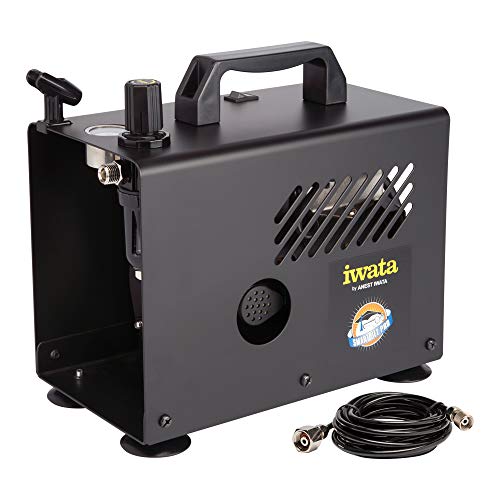
Iwata Smart Jet Pro Airbrush Compressor
1/6 horsepower tank-equipped compressor with an auto shut-off and quiet operation, designed specifically for single-airbrush hobby and art use.

Badger Patriot 105 Airbrush
American-made gravity-feed dual-action airbrush with a 0.5mm nozzle, built for durability and an excellent balance of control and ease of cleaning.

Master Airbrush TC-20 Tankless Compressor
Entry-level tankless compressor that delivers adjustable pressure from 0 to 57 psi, a practical starting point for painters buying their first airbrush setup.
What is zenithal priming and when is it worth the extra step?
Zenithal priming layers Citadel Chaos Black Spray from below and Vallejo Surface Primer Grey or Army Painter Color Primer Matt White Spray from directly above, building an instant light-and-shadow map before a single color goes on. Raised surfaces come out light and recesses stay dark, which mimics how real light falls across a three-dimensional object long before you pick up a brush. Run Citadel Chaos Black Spray Primer as the base layer and finish with Vallejo Surface Primer Grey (200ml) or Army Painter Color Primer Matt White Spray from directly overhead.
The payoff is speed later in the process. Every subsequent layer of color reads the existing light and shadow instead of you painting shadow and highlight from scratch, which is a meaningful time saving on a full army or a large batch of the same miniature. It also makes non-metallic metal and smooth blending noticeably easier, since the transition points are already marked out.
It is worth the extra step once you own an airbrush, since a fine, controllable spray is what makes the top-down pass land only where it should. Zenithal priming with a rattle can is possible but far less precise: the wide, unfocused spray pattern from an aerosol tends to wash out the effect on smaller miniatures, so it works best on larger models or terrain where exact placement matters less.
Citadel Chaos Black Spray Primer
The most-documented rattle-can primer in the hobby, a black basecoat and primer in one that works out of the can on any primed-plastic or metal miniature.
Vallejo Surface Primer Grey (200ml)
The hobby airbrush primer benchmark: a grey polyurethane-acrylic formula that bonds to plastic, resin, and metal and preserves fine detail better than any rattle-can.
Army Painter Color Primer Matt White Spray
White rattle-can primer that bonds to plastic and metal and provides a bright base for contrast paints, bright colour schemes, and bone tones.
How do you prime a miniature using the zenithal method?
Priming a miniature for zenithal shading with Citadel Chaos Black Spray and Vallejo Surface Primer Grey follows a simple two-pass sequence: a full black coat from every angle, then a lighter top coat sprayed only from directly overhead so highlights land where real light would. The full step list below works with either a rattle can or an airbrush, adjusting distance and pressure as needed, and pairs Citadel Chaos Black Spray Primer with Vallejo Surface Primer Grey (200ml) or Army Painter Color Primer Matt White Spray depending on which light color you are working toward.
Citadel Chaos Black Spray Primer
The most-documented rattle-can primer in the hobby, a black basecoat and primer in one that works out of the can on any primed-plastic or metal miniature.
Vallejo Surface Primer Grey (200ml)
The hobby airbrush primer benchmark: a grey polyurethane-acrylic formula that bonds to plastic, resin, and metal and preserves fine detail better than any rattle-can.
Army Painter Color Primer Matt White Spray
White rattle-can primer that bonds to plastic and metal and provides a bright base for contrast paints, bright colour schemes, and bone tones.
What temperature and humidity ruin a rattle-can prime job?
Citadel and Army Painter both print roughly 15 to 25 degrees Celsius and low humidity on the instructions for Citadel Chaos Black Spray and Army Painter Color Primer Matt White Spray, since colder air destabilizes the propellant and damp air causes a chalky frosted finish. Spraying Citadel Chaos Black Spray Primer or Army Painter Color Primer Matt White Spray outside that window is the most common reason a rattle-can prime job comes out rough instead of smooth.
Both manufacturers also print a ventilation warning directly on the can, since the aerosol propellant and solvent content are meant to be sprayed outdoors or in a well-ventilated space away from open flame, not in a closed room. This is a safety instruction from the product label, not a suggestion, and it applies to any rattle-can primer regardless of brand.
If you cannot control temperature and humidity where you are priming, a brush-on or airbrush primer sidesteps the problem entirely, since indoor application does not depend on outdoor air conditions the way an aerosol can does. Badger Stynylrez Airbrush Primer (2oz) and Vallejo Surface Primer Grey (200ml) both work indoors year-round with no weather dependency.
Citadel Chaos Black Spray Primer
The most-documented rattle-can primer in the hobby, a black basecoat and primer in one that works out of the can on any primed-plastic or metal miniature.
Army Painter Color Primer Matt White Spray
White rattle-can primer that bonds to plastic and metal and provides a bright base for contrast paints, bright colour schemes, and bone tones.
Badger Stynylrez Airbrush Primer (2oz)
Water-based polyurethane-acrylic primer in a hobby bottle format, with excellent surface adhesion and a high-build formula that fills minor surface flaws.
Vallejo Surface Primer Grey (200ml)
The hobby airbrush primer benchmark: a grey polyurethane-acrylic formula that bonds to plastic, resin, and metal and preserves fine detail better than any rattle-can.
Does primer color matter if you plan to use Contrast or Speedpaint formulas?
Army Painter Speedpaint 2.0 is formulated to self-shade over a light base such as Army Painter Color Primer Matt White Spray or Vallejo Surface Primer Grey, since the effect depends on primer showing through thin paint on every raised surface. Army Painter Speedpaint 2.0 Mega Set over black primer mostly just looks dark everywhere, because there is no light surface underneath for the thin coat to read against.
This is the one situation where the usual black-primer default actively works against you. If speedpaints or contrast-style paints are the plan for a miniature, prime it with Army Painter Color Primer Matt White Spray or Vallejo Surface Primer Grey (200ml) from the start rather than defaulting to black and hoping the effect still shows through.
Traditional base-and-shade painting is far more forgiving of primer color, since you are laying an opaque base coat over the primer regardless of what is underneath. Primer color matters most for contrast-style formulas like Army Painter Speedpaint 2.0 Mega Set and matters far less once you are painting with standard opaque acrylics on top.
Army Painter Speedpaint 2.0 Mega Set
50-colour set of Army Painter's self-shading speedpaint formula, improved over version 1.0 for reduced reactivation when layering over dried coats.
Army Painter Color Primer Matt White Spray
White rattle-can primer that bonds to plastic and metal and provides a bright base for contrast paints, bright colour schemes, and bone tones.
Vallejo Surface Primer Grey (200ml)
The hobby airbrush primer benchmark: a grey polyurethane-acrylic formula that bonds to plastic, resin, and metal and preserves fine detail better than any rattle-can.
Featured in this guide
Citadel Chaos Black Spray Primer
The most-documented rattle-can primer in the hobby, a black basecoat and primer in one that works out of the can on any primed-plastic or metal miniature.
Army Painter Color Primer Matt White Spray
White rattle-can primer that bonds to plastic and metal and provides a bright base for contrast paints, bright colour schemes, and bone tones.
Vallejo Surface Primer Grey (200ml)
The hobby airbrush primer benchmark: a grey polyurethane-acrylic formula that bonds to plastic, resin, and metal and preserves fine detail better than any rattle-can.
Badger Stynylrez Airbrush Primer (2oz)
Water-based polyurethane-acrylic primer in a hobby bottle format, with excellent surface adhesion and a high-build formula that fills minor surface flaws.
Iwata Eclipse HP-CS Airbrush
The gravity-feed, dual-action benchmark for miniature painting, with a 0.35mm nozzle and a large 7ml cup that handles both fine detail and broad basecoating.
Badger Patriot 105 Airbrush
American-made gravity-feed dual-action airbrush with a 0.5mm nozzle, built for durability and an excellent balance of control and ease of cleaning.
Iwata Smart Jet Pro Airbrush Compressor
1/6 horsepower tank-equipped compressor with an auto shut-off and quiet operation, designed specifically for single-airbrush hobby and art use.
Master Airbrush TC-20 Tankless Compressor
Entry-level tankless compressor that delivers adjustable pressure from 0 to 57 psi, a practical starting point for painters buying their first airbrush setup.
Army Painter Speedpaint 2.0 Mega Set
50-colour set of Army Painter's self-shading speedpaint formula, improved over version 1.0 for reduced reactivation when layering over dried coats.
Keep reading
Related comparisons
Related roundups
FAQ
Frequently asked questions
Should I prime miniatures black or white?+
Black is the safer default for most painters because it shades recesses automatically and forgives small mistakes, while white is worth the extra coats when you are painting bright colors or using contrast-style paints that need a light base to self-shade correctly. Grey is a reasonable middle ground when you have not settled on a color scheme yet.
Can I do zenithal priming with a rattle can instead of an airbrush?+
You can, but the wide, unfocused spray pattern from an aerosol makes it harder to keep the light top coat confined to only the upward-facing surfaces on a small 28mm miniature. It works better on larger models and terrain, where the effect does not need to be as precisely placed. An airbrush gives the control that makes zenithal priming worthwhile on smaller figures.
What temperature should I prime miniatures at?+
The instructions on Citadel Chaos Black Spray and Army Painter Color Primer Matt White Spray both put the safe window at roughly 15 to 25 degrees Celsius in dry conditions. Priming below that range makes the aerosol propellant inconsistent, and priming above it or in high humidity causes a chalky, frosted texture that never fully smooths out.
Can I brush on primer instead of spraying it?+
Yes. Badger Stynylrez Primer is formulated to work brushed on directly from the bottle as well as through an airbrush, which is useful for touching up bare spots a rattle can missed or for priming small conversion parts where a full spray pass is not practical. Standard rattle-can primers are not designed to be brushed and will not level properly.
Does primer color affect how contrast paints and speedpaints look?+
Yes, significantly. Army Painter Speedpaint 2.0 and similar contrast-style formulas are designed to self-shade over a white or light grey primer, since the effect relies on the light surface showing through the thin paint on raised areas. Over black primer, the same paint mostly just reads as a flat dark color with little of the automatic shading effect.