Setting Up an Airbrush for Miniature Painting
By BrushBench . 12 min read . Updated September 2026
An airbrush is the single biggest technical upgrade available to a miniature painter. Smooth colour transitions, fast priming of a full regiment, zenithal basecoating, and natural metallic effects all become accessible or significantly easier with an airbrush. The barrier to entry is not the skill, it is the setup knowledge. This guide walks through choosing the right airbrush and compressor, which paints work best, how to thin them correctly, and how to clean between colours so the session does not become a maintenance task. Start with the Iwata Eclipse HP-CS Airbrush and the Iwata Smart Jet Pro Airbrush Compressor and most of this guide becomes straightforward.
Quick answer
Choose a gravity-feed dual-action airbrush with a 0.3mm to 0.35mm nozzle, pair it with a tank-equipped compressor, and thin paints to a skimmed-milk consistency before loading the cup. Flush with water between colours and strip-clean with airbrush cleaner after each session. The Iwata Eclipse HP-CS and Iwata Smart Jet compressor is the setup most painters never replace.
This guide contains affiliate links. BrushBench may earn a commission at no cost to you.
Choosing the right airbrush for miniatures
For miniature work, nozzle size matters more than brand: 0.35mm is the sweet spot, fine enough for blends yet forgiving of normal paint. The Iwata Eclipse HP-CS ($140 to $175) uses that size; the tougher Badger Patriot 105 ($90 to $120) runs a coarser 0.5mm built for basecoating, not fine gradients.
The two most important decisions when buying an airbrush are the feed system and the nozzle size. Gravity-feed airbrushes, where paint sits in a cup on top of the brush and falls into the airstream by gravity, are the standard for miniature work. They waste less paint on small batches, produce a more consistent spray at low pressure, and are easier to clean than siphon-feed models.
Dual-action means the trigger controls both airflow and paint volume independently. Pulling the trigger back with your finger releases air first and then paint as you pull further back. This gives you control over spray width and paint volume that is essential for blending and detail work. Single-action brushes release air and paint together at the same ratio, giving you less control.
Nozzle size is where most beginners go wrong. A 0.5mm nozzle is too large for detail and gradient work on 28mm miniatures. A 0.2mm nozzle is precise but clogs constantly with anything less than perfectly thinned, particle-free paint. The 0.35mm nozzle on the Iwata Eclipse HP-CS Airbrush is the miniature hobby sweet spot: fine enough for smooth blends and basecoating, wide enough to be forgiving of normal paint particle sizes.
The Harder and Steenbeck Ultra 2 in 1 Airbrush offers a practical alternative if you want both 0.2mm for very fine work and 0.4mm for fast coverage in one brush. The nozzle swap takes a couple of minutes. The Badger Patriot 105 Airbrush is a robust beginner option if you primarily want to prime and base coat and are not yet focused on blending, though its 0.5mm nozzle limits gradient work.

Iwata Eclipse HP-CS Airbrush
The gravity-feed, dual-action benchmark for miniature painting, with a 0.35mm nozzle and a large 7ml cup that handles both fine detail and broad basecoating.

Harder and Steenbeck Ultra 2 in 1 Airbrush
German-engineered gravity-feed airbrush that ships with both a 0.2mm and 0.4mm nozzle head, covering fine detail through broad basecoating.

Badger Patriot 105 Airbrush
American-made gravity-feed dual-action airbrush with a 0.5mm nozzle, built for durability and an excellent balance of control and ease of cleaning.
Choosing the right compressor
A tank-equipped compressor matters more than the airbrush: it buffers piston pulsation so gradients stay smooth, not stuttering. The Iwata Smart Jet Pro ($370 to $400) is the purpose-built pick; the tankless Master Airbrush TC-20 ($50 to $80) is a fine start at 15 to 25 psi.
The compressor is as important as the airbrush. A pulsating, inconsistent pressure supply makes smooth gradients impossible regardless of how good the airbrush is. The key feature to look for is an air tank, which acts as a buffer and smooths out the piston pulsation that all oil-less compressors produce during continuous operation.
The Iwata Smart Jet Pro Airbrush Compressor is purpose-built for single-airbrush hobby use: the tank is appropriately sized, the auto shut-off prevents overheating during long sessions, and the operating noise level is tolerable in a home or flat. It pairs directly with the Iwata Eclipse and any other standard airbrush through a standard regulator fitting.
If budget is the constraint, the Master Airbrush TC-20 Tankless Compressor is a practical tankless entry point. The pulsation is noticeable on very smooth gradients but is not a problem for basecoating, priming, and rougher blending work. It is the right choice for painters who want to learn the medium before investing in a premium compressor.
Regardless of which compressor you choose, set your working pressure between 15 and 25 psi for miniature work. Higher pressure atomises paint aggressively and causes overspray. Lower pressure can cause sputtering if the paint is not thinned correctly.
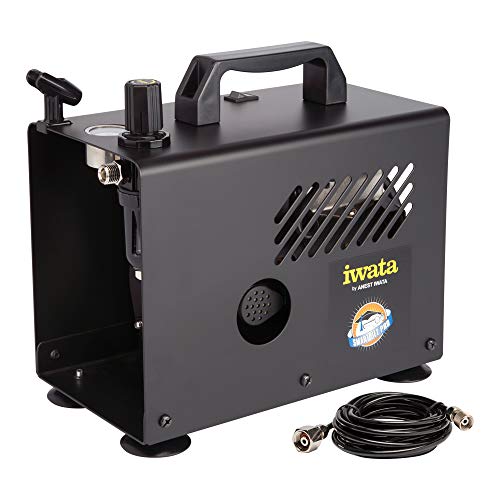
Iwata Smart Jet Pro Airbrush Compressor
1/6 horsepower tank-equipped compressor with an auto shut-off and quiet operation, designed specifically for single-airbrush hobby and art use.
Master Airbrush TC-20 Tankless Compressor
Entry-level tankless compressor that delivers adjustable pressure from 0 to 57 psi, a practical starting point for painters buying their first airbrush setup.
Which paints work in an airbrush
The easiest starting point is a purpose-formulated airbrush paint like the Vallejo Model Air Starter Set (16 Bottles). Model Air paints are pre-thinned to airbrush-ready consistency, run through a 0.3mm nozzle without adjustment, and cover a wide colour range for historical and fantasy miniatures. Load the cup directly from the dropper bottle.
Standard hobby acrylics like Citadel paints and Vallejo Game Color require thinning before they go through the airbrush. The target consistency is often described as skimmed milk: thin enough to flow freely and atomise cleanly, but not so thin that the pigment load drops below useful coverage. Start with a 1:1 ratio of paint to water or airbrush medium and adjust from there.
Adding Liquitex Airbrush Medium or Vallejo Airbrush Thinner rather than plain water improves flow and reduces tip dry, which is the dried paint ring that forms on the needle tip and causes splattering. A few drops of flow improver in your cup makes a noticeable difference when working with standard hobby acrylics.
For zenithal priming, the Vallejo Surface Primer Grey (200ml) is the airbrush primer standard. Thin it slightly with Vallejo Airbrush Thinner and run it at 20 to 25 psi. It is thicker than Model Air but gives a surface so smooth and well-bonded that subsequent paint layers adhere better than over any rattle-can prime.
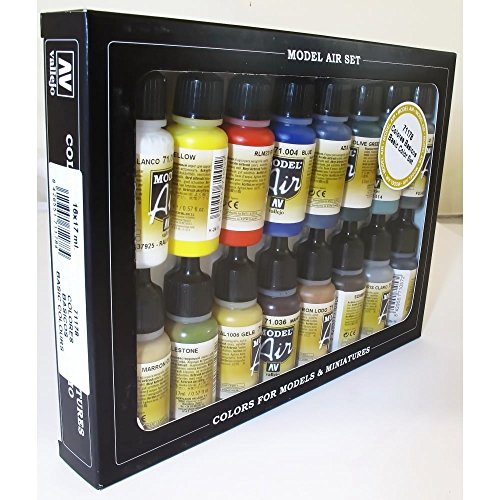
Vallejo Model Air Starter Set (16 Bottles)
Pre-thinned airbrush-ready acrylics in a 16-colour starter set, formulated to run through a 0.3mm nozzle without additional thinning.

Vallejo Surface Primer Grey (200ml)
The hobby airbrush primer benchmark: a grey polyurethane-acrylic formula that bonds to plastic, resin, and metal and preserves fine detail better than any rattle-can.
Cleaning between colours and at the end of a session
Between colours during a session, empty the remaining paint from the cup, add a few drops of clean water or airbrush cleaner, and spray through for 10 to 15 seconds until the spray runs clear. This quick flush is usually enough to change colours without a full disassembly.
At the end of every session, do a proper clean. Flush the cup with airbrush cleaner two or three times. Then remove the needle by loosening the needle lock, pull it out from the rear, wipe it with a cleaner-dampened cloth, and replace it. Unscrew the nozzle cap and wipe the front with a cotton swab dipped in cleaner.
Do not disassemble the nozzle itself after every session unless it is visibly clogged. Airbrush nozzles are precise, and over-disassembly leads to wear. A full strip-down, where you remove and soak the nozzle in cleaner, is a monthly maintenance step rather than a daily one. Consistent flushing after every session prevents most clogging.
Zenithal priming and basecoating with an airbrush
Zenithal priming turns flat basecoating into an instant shading map: spray black first, then light grey or white from directly above. Hold the airbrush 15 to 20 centimetres away at a 45 degree angle and run the highlight coat at 20 to 25 psi.
Zenithal priming is one of the most useful beginner airbrush techniques. Spray black primer over the entire miniature from all angles, then spray white or light grey from directly above. The light grey settles on raised surfaces and the black remains in recesses, giving you an instant shading map that makes every subsequent colour decision easier.
For zenithal work, use Vallejo Surface Primer Grey (200ml) as the light top coat over Citadel Chaos Black Spray Primer rattle-can black, or run black through the airbrush first and follow with white. Run the white at a slightly higher pressure, around 20 to 25 psi, from a distance of about 15 to 20 centimetres, holding the airbrush at a 45-degree angle from above.
Basecoating a full squad of 10 miniatures with an airbrush takes a fraction of the time of brush basecoating and gives a smoother, more even coverage. This alone justifies the airbrush investment for painters who batch-paint units. Load one colour, coat all ten, flush, load the next.
Vallejo Surface Primer Grey (200ml)
The hobby airbrush primer benchmark: a grey polyurethane-acrylic formula that bonds to plastic, resin, and metal and preserves fine detail better than any rattle-can.

Citadel Chaos Black Spray Primer
The most-documented rattle-can primer in the hobby, a black basecoat and primer in one that works out of the can on any primed-plastic or metal miniature.
Featured in this guide
Iwata Eclipse HP-CS Airbrush
The gravity-feed, dual-action benchmark for miniature painting, with a 0.35mm nozzle and a large 7ml cup that handles both fine detail and broad basecoating.
Iwata Smart Jet Pro Airbrush Compressor
1/6 horsepower tank-equipped compressor with an auto shut-off and quiet operation, designed specifically for single-airbrush hobby and art use.
Vallejo Model Air Starter Set (16 Bottles)
Pre-thinned airbrush-ready acrylics in a 16-colour starter set, formulated to run through a 0.3mm nozzle without additional thinning.
Vallejo Surface Primer Grey (200ml)
The hobby airbrush primer benchmark: a grey polyurethane-acrylic formula that bonds to plastic, resin, and metal and preserves fine detail better than any rattle-can.
Harder and Steenbeck Ultra 2 in 1 Airbrush
German-engineered gravity-feed airbrush that ships with both a 0.2mm and 0.4mm nozzle head, covering fine detail through broad basecoating.
Master Airbrush TC-20 Tankless Compressor
Entry-level tankless compressor that delivers adjustable pressure from 0 to 57 psi, a practical starting point for painters buying their first airbrush setup.
Badger Patriot 105 Airbrush
American-made gravity-feed dual-action airbrush with a 0.5mm nozzle, built for durability and an excellent balance of control and ease of cleaning.
Keep reading
Related comparisons
Related roundups
FAQ
Frequently asked questions
What is the best starter airbrush and compressor combination?+
The Iwata Eclipse HP-CS airbrush paired with the Iwata Smart Jet Pro compressor is the setup most miniature painters use long-term without feeling the need to upgrade. Both are purpose-built for hobby use, the 0.35mm nozzle on the Eclipse handles the full range of miniature work, and the Smart Jet's tank delivers stable, pulsation-free pressure. If the combined cost is too high initially, the Master Airbrush TC-20 compressor with the Eclipse is a reasonable starting compromise.
How thin should I make my paint for airbrushing miniatures?+
Aim for a consistency like skimmed milk: thin enough to flow freely and atomise without sputtering, but not so thin that the pigment load drops. Start with a 1:1 ratio of paint to water or airbrush medium and test the flow on a piece of card before loading the cup. If the paint splatters or sputters, thin slightly more. If coverage is weak and watery, thicken slightly. Purpose-made airbrush paints like Vallejo Model Air are pre-thinned and require no adjustment.
Do I need a dedicated airbrush primer or can I use rattle-can primer before airbrushing?+
You can use rattle-can primer and then airbrush over it. Many painters prime with Citadel Chaos Black from a can and then do zenithal highlighting or basecoating through the airbrush. Airbrush-through-primer like Vallejo Surface Primer gives thinner coats that preserve more surface detail and costs less per miniature, but requires the airbrush setup to be ready before priming. Either approach works.