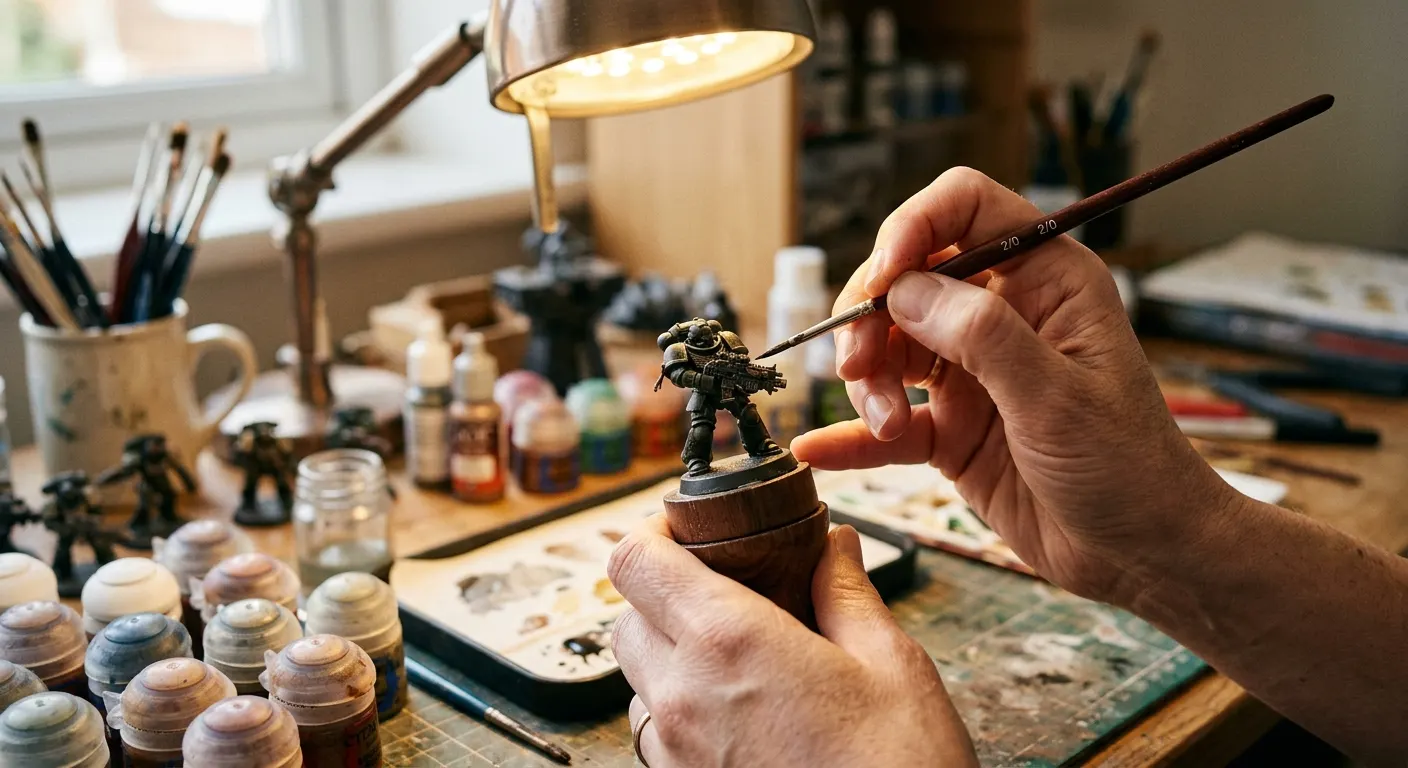
How to Use Washes and Shades on Miniatures
By BrushBench . 9 min read . Updated June 2026
Washes are the fastest technique upgrade in miniature painting. A flat base coat looks amateur. That same base coat after a wash looks finished, shaded, and three-dimensional. The reason is simple: washes are very thin, ink-like paints that flow off raised surfaces and pool in the recesses under capillary action, automatically placing shadows exactly where real light would not reach. The Citadel Shade Paint Set (8 Pots) contains the two most used paints in the hobby, Agrax Earthshade and Nuln Oil, alongside six other shades that cover every colour family. This guide covers the all-over wash, targeted recess shading, fixing tide marks, and how shading relates to contrast and speedpaint formulas.
Quick answer
Apply Citadel Agrax Earthshade diluted slightly with water over a primed, base-coated miniature, let it flow into every recess, and let it dry before highlighting. This step adds shadow depth and visual weight to a flat base coat in under five minutes. The Citadel Shade Paint Set adds Nuln Oil and six more shades to cover every colour family.
This guide contains affiliate links. BrushBench may earn a commission at no cost to you.
What a wash actually does
A wash is a paint formulated with extra flow agents and very low viscosity. When you apply it to a miniature, surface tension and capillary action pull it away from raised edges and into the narrow gaps between details. The pigment settles in those low points and dries there, producing darker values in the recesses without your having to place each shadow stroke by hand.
The result is automatic, physically accurate shading. Undercuts, gaps between armour plates, the folds of a cloak, the spaces between facial features: the wash finds all of them. On a base-coated miniature, one application of wash does what would otherwise take a dozen individual shadow strokes.
This is why the Citadel Shade Paint Set (8 Pots) is so widely recommended regardless of which brand a painter uses for their base coats. Agrax Earthshade and Nuln Oil are the two most referenced paints in the hobby because they work on almost every colour family: Agrax on browns, golds, reds, flesh tones, and earth colours; Nuln Oil on blacks, metallics, greys, blues, and most cool tones.

Citadel Shade Paint Set (8 Pots)
Eight of the most-used Citadel shade washes in one set, including Agrax Earthshade and Nuln Oil, which are staples in almost every painter's kit.
The all-over wash: basic technique
Start with a fully base-coated miniature where every surface has at least one coat of opaque colour. Do not wash a miniature that has any bare grey primer showing, as the wash will stain the primer in a way that is hard to correct later.
Load a medium-sized brush, a size 2 round or the large wash brush from the Army Painter Wargamer Regiment Brush Set, with shade paint. The brush should be well loaded but not dripping. Apply the wash over the entire miniature, using the brush to guide it into recesses and off raised flat areas. Work quickly on each area before the wash starts to dry, as going back over a drying wash creates a visible tide mark.
Allow the wash to dry completely. Acrylic shades take 10 to 20 minutes depending on the thickness of the application and ambient humidity. Do not try to correct, blend, or highlight while the wash is still wet. The capillary action is still working and any intervention disrupts it.
Once dry, assess the result. The recesses should be noticeably darker than the raised surfaces. The raised faces of armour, muscle, and cloth may look slightly duller than the original base coat. This is normal and will be corrected by the highlight step that follows, which sits on top of the now-shaded base.
Citadel Shade Paint Set (8 Pots)
Eight of the most-used Citadel shade washes in one set, including Agrax Earthshade and Nuln Oil, which are staples in almost every painter's kit.

Army Painter Wargamer Regiment Brush Set
Seven-piece synthetic brush set covering the key sizes for basecoating, layering, washing, and detail work, with a dedicated drybrush.
Which shade to use on which colours
Shade selection follows colour temperature. Warm colours, including flesh tones, browns, oranges, reds, and golds, are shaded with warm washes. Agrax Earthshade from the Citadel Shade Paint Set (8 Pots) is the universal warm shade: it reads as a rich brown that deepens almost every warm colour without shifting the hue too far.
Cool colours, including blues, greens, silvers, blacks, and cold greys, are shaded with cool or neutral washes. Nuln Oil from the same set is the go-to for metallics and anything that needs a neutral dark shadow without warmth. It is the correct choice for silver chainmail, black armour, and gunmetal weapons.
Purple, magenta, and violet miniatures benefit from Druchii Violet or Carroburg Crimson, both included in the Citadel shade range. Skin tones on character models are often washed with a flesh-toned shade like Reikland Fleshshade, which produces a softer transition on faces than Agrax does. Green miniatures shade well with either Biel-Tan Green for a saturated result or Athonian Camoshade for a more naturalistic desaturated green.
Mixing shades is also effective. A drop of Agrax Earthshade mixed with a drop of Nuln Oil produces a dark neutral that works on almost every colour family, useful when batch-painting a varied colour scheme and you want one shade pass to cover everything.
Citadel Shade Paint Set (8 Pots)
Eight of the most-used Citadel shade washes in one set, including Agrax Earthshade and Nuln Oil, which are staples in almost every painter's kit.
Recess shading for cleaner results
The all-over wash is fast, but it has one limitation: it can leave flat surfaces looking slightly chalky or uneven as the wash pools at the edges of raised areas and leaves a visible ring. This is the tide mark, and it is the most common beginner wash problem.
Recess shading solves this by applying the shade only in the deepest recesses with a fine brush rather than flooding the entire miniature. Use a size 0 round brush like the Raphael 8404 Kolinsky Sable Brush Size 1 loaded with thinned shade paint. Place the tip of the brush at the entrance to a recess gap and let the paint wick in by capillary action. The brush barely touches the miniature and the paint flows where it needs to go.
This technique is slower than an all-over wash but produces significantly cleaner results on flat armour panels, smooth robes, and any area where tide marks would be visible. Many painters combine both approaches: all-over wash for organic surfaces like skin, leather, and cloth, and recess shading for flat armour and weapon blades.
Thin the shade paint to about 1:1 or 1:2 shade to water for recess shading. At this dilution, the paint flows more freely into narrow recesses and dries with less visible pooling at the edges. Use the Redgrass Games Everlasting Wet Palette Painter XL to hold both the thinned shade and your base colour so you can touch up any runs immediately while the shade is still wet.
Raphael 8404 Kolinsky Sable Brush Size 1
The hobby community's benchmark Kolinsky sable brush: a fine point that holds its tip through long sessions and snaps back cleanly between strokes.

Redgrass Games Everlasting Wet Palette Painter XL
The benchmark wet palette for miniature painters, with a calibrated hydration sponge, quality semi-permeable paper, and a sealing lid that keeps paint workable for days.
Fixing tide marks and pooling
A tide mark is the visible ring that forms when a wash dries at the edge of a pool on a flat surface. It happens when too much wash was applied and it pooled rather than flowing into recesses. The fix is to either prevent it or to paint over it.
Prevention: load the brush with less shade, work in smaller sections, and use a dry brush tip to wick excess wash off flat surfaces immediately after applying it to the recesses nearby. A lightly damp brush drawn across a flat panel pulls the excess shade off before it can form a ring.
Correction after drying: thin a small amount of your original base coat to a thin glaze consistency on the Redgrass Games Everlasting Wet Palette Painter XL and paint over the stained flat area in thin layers, feathering the edges. Two or three thin glaze coats rebuild the flat colour without covering the recess shading underneath. This is the same correction technique whether you used Agrax Earthshade over leather or Nuln Oil over a metal blade.
Using a dedicated medium like Lahmian Medium mixed into the shade before applying reduces pooling by increasing the drying time and allowing capillary action to move more of the pigment into the recesses before the paint locks. It is not essential with practice, but it makes the all-over wash significantly more forgiving during the learning phase.
Redgrass Games Everlasting Wet Palette Painter XL
The benchmark wet palette for miniature painters, with a calibrated hydration sponge, quality semi-permeable paper, and a sealing lid that keeps paint workable for days.
Contrast and speedpaint formulas as a shade-and-base in one
The Citadel Contrast Starter Set (6 Pots) and Army Painter Speedpaint 2.0 Mega Set use a similar physical mechanism to washes but with a higher pigment load that is designed to do the job of a base coat and a shade simultaneously. Apply them over a white or light grey primer and they flow into recesses and leave raised areas lighter, producing a base-coated and shaded result in a single step.
These formulas work best over the Army Painter Color Primer Matt White Spray or Citadel Grey Seer primer. Over black primer the colours are too dark and the recess separation is not visible. The technique is faster than a traditional base-and-shade sequence and works very well for batch-painting rank-and-file troops where each model does not need a display-quality finish.
The distinction between using contrast-style paints and using a traditional wash over a solid base is significant. A traditional wash on a high-pigment base coat gives you more colour saturation and more control over the final shade position. Contrast-style formulas are faster and more consistent across a large batch but the colour depth is shallower. Many experienced painters use contrast paints for the base and shade step on secondary colours and reserve traditional washes for the most visible surfaces on a model.
Citadel Contrast Starter Set (6 Pots)
Six core Contrast colours that combine basecoat and shade in a single application, designed for fast, high-quality results on textured surfaces.

Army Painter Speedpaint 2.0 Mega Set
50-colour set of Army Painter's self-shading speedpaint formula, improved over version 1.0 for reduced reactivation when layering over dried coats.

Army Painter Color Primer Matt White Spray
White rattle-can primer that bonds to plastic and metal and provides a bright base for contrast paints, bright colour schemes, and bone tones.
Shading metals and NMM
Metallic paints respond well to shade washes, and the result is one of the fastest improvements available for a quick gaming standard. A silver metallic base coat followed by a Nuln Oil wash from the Citadel Shade Paint Set (8 Pots) produces convincing recessed shadows on chainmail, plate armour, and weapon blades in two steps.
Gold and bronze metallics shade correctly with Agrax Earthshade. The warm brown tone of the shade reads naturally against gold and creates a realistic tarnished or shadowed finish. Apply liberally all over gold armour and let it flow. The result before highlighting already looks table-ready.
If you are working with the Vallejo Game Color 16-Bottle Starter Set, the gold and silver colours in the range shade effectively with the Citadel shades as cross-brand mixing of wash and base coat is straightforward. The main variable is surface preparation: metallic paints adhere best over a grey primer like the Vallejo Surface Primer Grey (200ml), which gives a neutral tone under the metallic sheen.
Citadel Shade Paint Set (8 Pots)
Eight of the most-used Citadel shade washes in one set, including Agrax Earthshade and Nuln Oil, which are staples in almost every painter's kit.

Vallejo Game Color 16-Bottle Starter Set
The most practical beginner palette in the hobby: 16 dropper-bottle acrylics covering every major colour group, formulated for plastic and metal miniatures.

Vallejo Surface Primer Grey (200ml)
The hobby airbrush primer benchmark: a grey polyurethane-acrylic formula that bonds to plastic, resin, and metal and preserves fine detail better than any rattle-can.
Featured in this guide
Citadel Shade Paint Set (8 Pots)
Eight of the most-used Citadel shade washes in one set, including Agrax Earthshade and Nuln Oil, which are staples in almost every painter's kit.
Vallejo Game Color 16-Bottle Starter Set
The most practical beginner palette in the hobby: 16 dropper-bottle acrylics covering every major colour group, formulated for plastic and metal miniatures.
Raphael 8404 Kolinsky Sable Brush Size 1
The hobby community's benchmark Kolinsky sable brush: a fine point that holds its tip through long sessions and snaps back cleanly between strokes.
Redgrass Games Everlasting Wet Palette Painter XL
The benchmark wet palette for miniature painters, with a calibrated hydration sponge, quality semi-permeable paper, and a sealing lid that keeps paint workable for days.
Citadel Contrast Starter Set (6 Pots)
Six core Contrast colours that combine basecoat and shade in a single application, designed for fast, high-quality results on textured surfaces.
Army Painter Wargamer Regiment Brush Set
Seven-piece synthetic brush set covering the key sizes for basecoating, layering, washing, and detail work, with a dedicated drybrush.
Keep reading
Related comparisons
Related roundups
FAQ
Frequently asked questions
What is the difference between a wash and a shade in miniature painting?+
In practice they are the same thing: a very thin, low-viscosity paint formulated to flow into recesses by capillary action and pool there to create shadow depth. Games Workshop markets their range as Shades; Army Painter calls them Washes; Vallejo uses both terms. The technique for applying them is identical regardless of brand. Some painters also use the word "wash" to describe any paint thinned to a very watery consistency for the same purpose, including thinned standard paints.
Should I dilute my wash or use it straight from the pot?+
For an all-over wash on a small 28mm miniature, use it straight from the pot. The formula is already calibrated for this use. For recess shading with precise placement, thin it 1:1 with water or medium so it flows more freely into narrow gaps with less pooling on flat surfaces. Diluting too much reduces the pigment load and makes the shade less visible after drying, so test on a primed spare piece before working on a finished model.
What colour wash should I use on flesh tones?+
Reikland Fleshshade from the Citadel Shade range is formulated specifically for skin tones and produces a softer, warmer shadow than Agrax Earthshade. Agrax Earthshade works on flesh but reads slightly more brown and less pink. For a naturalistic skin result, Reikland Fleshshade applied all over a flesh base coat and allowed to pool in facial recesses is the standard approach used in most Games Workshop painting guides.
Why does my wash dry with an uneven chalky look on flat surfaces?+
This is the tide mark problem, caused by too much wash pooling on flat surfaces rather than flowing into recesses. It is most visible on smooth armour panels and large flat cloaks. Prevent it by applying less wash at a time, working in small sections, and wicking excess wash off flat areas with a slightly dry brush before it dries. To correct it after the fact, apply thin glaze coats of the original base colour over the affected area, feathering the edges.
Can I use washes directly on bare plastic without a primer or base coat?+
Technically the shade paint will adhere to plastic, but the result is almost always poor. Without a primer coat, the shade does not bond reliably and can be wiped off with handling. Without a base coat, the shade sits directly on the grey plastic tone and the shadow separation is not visible because there is no lighter surface for it to contrast against. Always prime and base coat before washing.
Do I need a separate wash brush or can I use my regular painting brushes?+
Your regular size 1 or 2 round brush works for washes, but many painters keep a dedicated medium round for all-over wash application because the brush gets heavily loaded and repeatedly dunked in shade paint, which is harder on bristles. The large wash brush from a set like the Army Painter Wargamer Regiment Set is purpose-built for this. Reserve your best sable brushes for detail work and use a synthetic for wash steps.